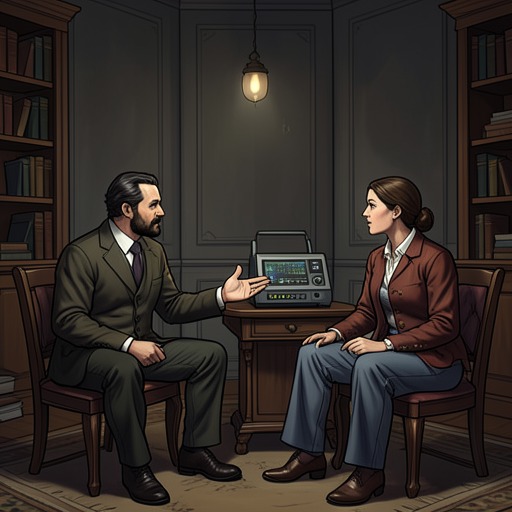
Duncan
The Portable DoorDuncan is Paul Carpenter’s friend of nearly a decade and Jenny’s partner. In the pub meeting arranged to celebrate Paul’s first paycheck, he becomes both a familiar companion and a measure of the adult life Paul feels he has only just begun: Duncan has a successful career, a settled relationship, and an ease with growing up that Paul greets with humor and envy.
Identity and Background
Duncan and Paul have known each other for close to ten years. Their friendship began in shared enthusiasms: they built model Spitfires and discussed the minutiae of Romulan uniforms when, in Paul’s comic account, women were still only a distant prospect. Those details give their friendship a history older than the romantic and professional changes now reshaping their lives.
Two years before the pub scene, Duncan met Jenny at a New Year’s party. Paul describes the pair as having become almost inseparable, a union of two reasonable people that, viewed together, exasperates him. His language deliberately makes a couple seem like a single combined creature; the exaggeration belongs to Paul’s perspective, not to any evidence that Duncan and Jenny have actually abandoned their separate identities.
Work and Adult Life
Duncan has recently been promoted to assistant deputy software wizard. Paul understands that the promotion has made Duncan’s earnings greater than Paul’s father’s income had been when he retired. The comparison sharpens Paul’s private envy: his friend’s advancement makes adult working life appear to have rewarded Duncan handsomely, even as Duncan complains that work cuts into free time.
At the gathering, Duncan asks Paul what he thinks of being grown up and whether his new employers have fired him yet. Paul answers that they would first have to notice he existed. The exchange makes their different positions visible without turning the conversation into a serious reckoning: Duncan can tease from the security of a promotion, while Paul answers with a joke about his own obscurity as a junior employee.
Duncan also presents work as an intrusion on leisure. He mentions being dragged out of bed in the middle of the night and losing the chance to watch afternoon television, then notes that plenty of people swear by employment all the same. His complaint is playful rather than a rejection of his success; in Paul’s eyes, Duncan remains fortunate enough to have both a rising career and the freedom to grumble about it.
Friendship with Jenny and Paul
Paul’s irritation is directed especially at Duncan and Jenny as a couple. He recalls that Jenny quickly acquired interests associated with Duncan, including bar billiards, real ale, television science fiction, football, and late-night fish and chips on the Embankment. He had initially suspected that this apparent compatibility was a kind of protective mimicry, but after two years he accepts that their arrangement is genuine. Their happiness therefore frustrates him precisely because it is not exposed as a trick or temporary performance.
The couple’s affection remains conspicuous during the pub visit. As they play cards, Duncan and Jenny pause at crucial moments to rub noses and nibble each other’s faces. Jenny also wins nearly every game of nomination whist, while Duncan wins one. Paul finds their behavior and good fortune irritating, but he still values the evening: playing cards with an old friend, even alongside the friend’s intensely affectionate partner, restores a sense of normality.
The First-Paycheck Gathering
Paul arranged to meet Duncan and Jenny a month earlier to celebrate cashing his first paycheck. They are the only people in his narrow circle of friends who could make it, and Paul arrives late. Duncan points out the lateness; Paul responds with an elaborate joke about a distorted anti-chronaton nexus and being reborn as a Viking chieftain in an alternate universe. The absurd excuse lets their familiar banter resume immediately, even as the occasion marks a real change in Paul’s working life.
The conversation shifts from adulthood to Paul’s job, then to Jenny’s practical intervention when she goes to fetch drinks. Paul asks for a half of lager shandy, but Jenny refuses to let him settle for it and heads through the crowded pub. Later, the three play nomination whist for two hours. Jenny’s sharp assessment of one of Paul’s bids leads her to conclude that he is obviously in love; the remark places his romantic feelings in the room without making Duncan the person who diagnoses them.
By the end of the evening, Paul notices that Duncan and Jenny regard him somewhat differently. He has moved, in their estimation, from being the friend without a job or girlfriend to a low-ranking apprentice in the vast enterprise of adult life. They have not suddenly made him their equal, as Paul’s wry description makes clear, but they now recognize him as having entered the same world of work. Duncan’s role in the scene is thus double: he remains the old friend with whom Paul can play cards and trade jokes, while his success and settled partnership expose the distance Paul still feels between himself and adulthood.